Mirror, Signal, Manoeuvre
Passing a learner driver the other night, I reflected on the first thing we learn when we start driving – mirror, signal, manoeuvre. It’s the way we successfully make it from A to B. What if we applied these principles to the way we drive our leadership?
When we drive a car we are hopefully looking forward at the road ahead, driving towards our desired destination. We use our mirrors to scan our environment and know what’s going on around us. We make an extra effort by checking our blind spot and then, if we are going to do something other drivers might not be expecting, something outside of the norm, we let them know by flicking our indicators on. Finally we make our move.
However when developing ourselves, we tend not to signal our intent. There’s a real temptation to keep development areas to ourselves, to not let others know what we are up to. So often when I’m coaching leaders I hear, “I’m trying to change but people are just suspicious of how I’m behaving now – I’m coming over as disingenuous, strange, clumsy”, and, “How am I ever going to stick with my desire to change and develop if I get that reaction!”
Martin was working on practising his listening skills, in particular generous listening. He didn’t tell his team that this is what he was working on, and sat through a meeting listening quietly. The team, who were used to him expressing his views with gusto, experienced him as disengaged and uninterested rather than listening to them generously. As you can imagine, Martin felt dispirited by the feedback from his team, and only then told them what he was practising, engaged them in what he was working on, and asked them for their support – which they were more than glad to give him.
Leadership nudge: How much time and energy are others using up in guessing what you are up to and going down blind alleys and, or bumping up against you – and you into them? How could you signal your intent more clearly, and engage others in what you are working on and encourage others to do the same around you?
By Alison Atkins
With a background of HR Partnering roles, Alison currently specialises in Leadership Development at Boots. To contact Alison directly, email alison.atkins1@ntlworld.com
Taken last Saturday on the Lancashire coast - click for a larger view
Alex Batchelor, Chairman of The Marketing Society, has rumbled me! As part of adding the 25th five star review of the book on Amazon – please add your review; you don’t need to buy a book to add a review, you just need an Amazon account – he writes that “FED (Future Engage Deliver) is a genuinely great tool…. for every leadership situation. But I suspect that Steve really wants people to use FED to make their lives better, rather than just read about it!”
He’s right! We do want to help you be a more effective leader but much more we want to do what we can to help you live a fuller life, at work and at home. This is why this week’s message is “please please avoid these 5 major life regrets which ring so strongly with FED messages.
They have been the ones most heard by Bronnie Ware who has spent years nursing the dying. The final regrets she’s most heard are:
- I wish I’d had the courage to live a life true to myself, not the life others expected of me.
- I wish I didn’t work so hard.
- I wish I’d had the courage to express my feelings.
- I wish I had stayed in touch with my friends.
- I wish that I had let myself be happier.
Which regrets might you be headed for when your sun sets?! What changes can you make to avoid them?
I’ve printed off Bronnie’s page on these regrets and it’s gone in my notebook so I can check how I’m doing now and again. Print them off. Talk to your support team about them. Make some decisions now. Have a good week – and beyond! Steve…
Monument Valley from a different angle, January 09 - click for a larger view
We can spend a lot of time thinking about ourselves and how we are doing as a leader. But here’s another place to look. Ultimately, your leadership shows up in your impact on others. So why not have a good look there? One of my favourite writers, Larry Bossidy, guides you nicely:
“How am I doing as a leader? The answer is how are the people you lead doing. Do they learn? Do they visit customers? Do they manage conflict? Do they initiate change? Are they growing and getting promoted? You won’t remember when you retire what you did in the first quarter of 2009, or the third. What you’ll remember is how many people you developed. How many people you helped have a better career because of your interest and your dedication to their development? When confused as to how you’re doing as a leader, find out how the people you lead are doing. You’ll know the answer.”
Not many of us fully grasp the difference we are making to others and the impact we can have on them. Notice your impact on others this week and make it even more positive and liberating.
Have a good week,
Steve
Alan Humphries - FED Consultant
Terry always seems to be at the gym no matter what time of day I show up. He came fourth place in the over 65′s World Triathlon Championships in Vancouver last year. A few months ago we were on adjacent machines and I asked him about how often he goes to the gym. “Well last year they were closed for three days so it must have been 362 times.” He then added: “And never once have I left not feeling better in myself.”
This got me thinking about the Four Energies of a leader – the physical, emotional, intellectual and spirit energies – and it being our energy that as leaders we need to manage and just how remarkable it is that when we feel like we’re running on empty and we do some physical exercise we feel better. Not only do we seem to have more physical energy again but our spirits are lifted also.
As Peter Drucker says: ‘the first and foremost job of a leader is to manage her or his energy and to then help those around them to manage their energies’.
So this week take some time to reflect on how you replenish your energies. Does going to the gym do it for you? What makes you feel better? What gives you energy? And how can help others to manage their energies?
By Alan Humphries, FED consultant and coach
Anni Townend
The following post is the first in series. We want to hear from you about films that have inspired you as a leader, that you’ve really enjoyed and that have had you reflect on your leadership.
The short answer to this question is: Relationships. I am fascinated by relationships, in particular what makes for a big relationship and how brilliant leadership really does happen inside of big relationships. It was this fascination that had me watching the film The Damned United about Brian Clough and Leeds United, where he spent 44 days, on his own as manager of the club before being sacked. Clough is remembered by football fans as ‘the best manager England never had’ whilst others of you have probably never even heard of him.
It is the 44 days on his own as manager that is so striking. Clough had enjoyed a big relationship with his assistant manager, Peter Taylor, for many, many years. Until they went their separate ways after a huge fall out. They had been a team of two who inspired others to work together as a team, and importantly to want to be part of their success. Footballers would follow them wherever they went. People who worked with them describe there being a real spark between them. On his own Brian stumbled and eventually fell. He had no one to share the ups and downs with, no one to turn to when he felt dispirited, and he felt dispirited at Leeds.
In simple terms when he went on his own to Leeds, Clough turned away from the vital relationship which helped him be such a brilliant leader. He needed Taylor’s different qualities and skills. He thrived when there was that openness and trust and without it he quickly became isolated and ineffective. Thankfully after the Leeds debacle he apologised to Peter Taylor, and together they went on to inspire future generations of footballers and their success.
Leadership inquiry: take some time this week to think those people who support and challenge you and help you be your best. Who are they? What are the qualities and characteristics of these relationships? How can you grow these relationships? How have you thanked the people for their support and challenge?
And let us know what you have taken out of a film you have watched.
Learn more about Anni Townend, the author of this article – click here
Anni Townend
One of the many challenges of bee-keeping for me is that of overcoming my stress around being stung. This challenge has in large measure spurred me on to enquire in to ways of bee-keeping that are about getting to know the bees and to understand them. The hope being that this approach to bee-keeping will mean that they are more friendly towards me and collaborate rather than being angry and scared.
I was reflecting on my approach to bee-keeping and on a conversation that I had with a leader about recent research into our stress response. In addition to the fight, flight, freeze response there is another response, that of tending and befriending. This response has us reach out to others, to build relationships with them, to give support and to be supported by them. It has us stay in At Your Best/Playing to Win mindset in which the focus is on co-invention and connection in recognition of the fact that your success is my success, and that we are in this and up to something together. Unlike the Just Surviving/Playing to Avoid Losing mindset which has us very much struggling, reacting out of fear and, or anger to others rather than reaching out to them, building relationships and allowing them to reach out to us.
This week give some thought to how you are responding, especially when you are challenged and, or feel stressed. Take a moment to see how you can reach out to others and or let them reach out to you.
You can read more about the different mindsets of At Your Best/Playing to Win versus Just Surviving/Playing to Avoid Losing in ‘Leadership: Plain and Simple’ and ‘How to make a Bigger Difference.’
Learn more about Anni Townend, the author of this article – click here
Anthony Landale
As well as being a consultant I’m also a writer and I a few years ago I interviewed Ben Zander, the conductor of a major orchestra, the Boston Philharmonic, and a teacher of gifted young musicians to find out about his motivational approach.
Now when Zander’s young musicians arrive on the first day, of their first term, at the college where he teaches he adopts an unusual strategy. Instead of demanding complete commitment and stringent practice as the only sure way for his students to achieve success, he hands them a certificate on which it shows that they have been awarded straight A grades for the entire programme.
Of course you might imagine how these highly talented musicians, brought up to measure their progress solely by how well they have passed one examination after another, respond to such a gesture. For most it is extremely frustrating and confusing. Where is the motivation, they ask themselves, if they have already achieved an A grade before even playing one note?
Zander of course wants just such a reaction. And in answer to his students’ protests he then asks them all to write to themselves as if they’ve just finished the course, explaining exactly what they had done to deserve the A grade they’ve been awarded.
“You see,” he explained “I have no doubts about the ability of any of my students. But I do not see it as my role to demand that they work hard; they have been taught that already. My work as a teacher is to put them in touch with the person they want to become; and to help them recognise exactly what it would take of them to get there. It isn’t my critical ear but their own inner vision that matters.”
Leadership nudge: Who is the person you want to be and what will it take for you to get there? Imagine talking to your colleagues about who they want to be and what it will take for them to get there. Who would most benefit from that conversation? Is there anything stopping you from having that conversation this week?
Learn more about Anthony Landale, the author of this article – click here
Ian Lock
Human beings are fantastic. I’m constantly reminded of this especially when I’m talking with people who are ‘up to something’ big. These people are aware that they need to draw on something special to pull it off. For many of us being at our best or the best we can imagine is enough to get us to the future we want. For those that are up to something big and transformative being at their best may not be enough – they have to be extraordinary.
So what does being extraordinary look and feel like? It starts with who you are being. It’s not about doing extraordinary things, that will come anyway, it’s about being an extraordinary leader. It is about paying close attention to your sense of future and purpose, it is about constantly managing the energy around you, it is about helping yourself and others to imagine and hold possibilities that were previously unimaginable, it is about paying attention to your leadership in everything that you are doing and bringing focus and clarity to the people around you. History is full of people who have pulled off the impossible and in some way they have all been extraordinary.
So think of you at your best as a leader and use this as your baseline and then think way beyond this to your being extraordinary. Imagine what being even bigger, better and bolder as a leader will look like for you. Pick one part of what you are up to today and choose to go and be extraordinary and see what happens.
Learn more about Ian Lock, the author of this article – click here
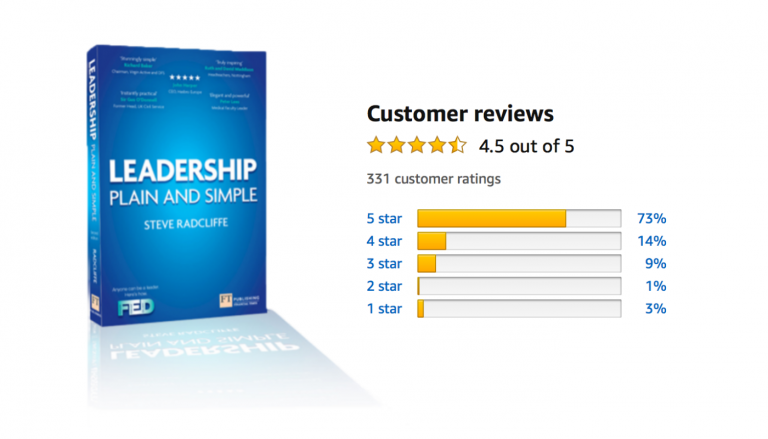
Hi, it’s a different sort of article this week. I just wanted you to know how well FED is doing and to thank you for your support. A marker of how far FED is spreading is that last week Leadership Plain and Simple became Amazon UK’s number one book on leadership. If you’ve not looked on the site (amazon.co.uk), you’ll enjoy reading some of the 23 five star reviews. Indeed, if you have an Amazon account please go on and add another, you don’t need to buy a book.
At the same time, it’s great that we’ve been adopted by The Marketing Society who are recommending us to all their members. Together with them, we’ve created Leadership Central (Marketing Society) where we post weekly articles about FED. And I’m looking forward to speaking at their annual conference on November 18 alongside some pretty impressive leaders (Marketing Society conference).
Next, we’ll be offering some workshops that you might want to come to or recommend to others so they get a taste of FED. I’ll run 3 one-day FED workshops in London on September 6, 16 and 22. There’ll be a small group for senior leaders, another one for emerging leaders and a big group for anyone. There’ll be more details on the site soon.
Otherwise, thanks again for your support of FED. You’ll have seen more people writing pieces for the site. Please join in. Just click “What’s your comment or question?“, or if you prefer, send a draft to anni.townend@mail.com, and appear in print!
And finally, this photo is crying out for a caption! If only he’d listened! What’s your caption?

Have a good week, Steve
Chris van Schaick
Quite a bit, you realise, when you step inside the National Portrait Gallery. The entrance, just behind Trafalgar Square, is on a well worn path to and from West End offices and Whitehall corridors. I’d walked past many times until I promised myself I’d go inside once in a while and get uplifted.
And here on the ground floor, in the 1990-onwards permanent collection, are all sorts of familiar people. Inspiring people. All with flaws, but all of them up to something – and with a resolution to do something about it. You can see it in the pictures.
Here’s Mo Mowlam, when she’d changed the landscape of Northern Ireland. Next to her is Johnson Beharry, shortly after becoming first living person to be awarded the Victoria Cross in two generations. He saved 30 comrades in Iraq. Round the corner is Michael Eavis – inspired by a local blues event to start the Glastonbury festival in 1970. Across the way is Amy Williams, who was Britain’s first individual gold medallist at the Winter Olympics for thirty years – in the “Skeleton” event. And over there is Sir Paul Nurse. He won a Nobel prize trying to outwit cancer.
What unites them? Well unlike in the Peter Cook comedy skit, their eyes don’t follow you round the room. They’re too busy for that. Behind their eyes, they’re all thinking like mad. They’re engaging with the artist of course. But their non-stop thinking about what they’re up to hasn’t been allowed to pause for a moment. Even for a portrait.
Take a moment this week to think about what you’re up to. And when you’ve got a moment, pop into the National Portrait Gallery, www.npg.org.uk. There’s the old saying: ‘Every picture tells a story’ – what story would your picture tell about what you are up to?
Chris van Schaick is a facilitator and communicator who has worked with Steve Radcliffe at the BBC. chris@chrisvanschaick.co.uk or www.chrisvanschaick.co.uk